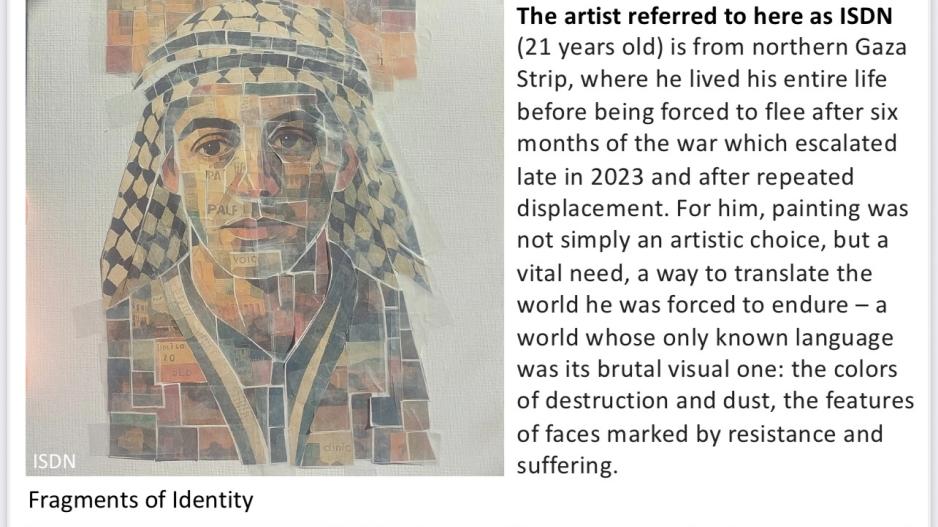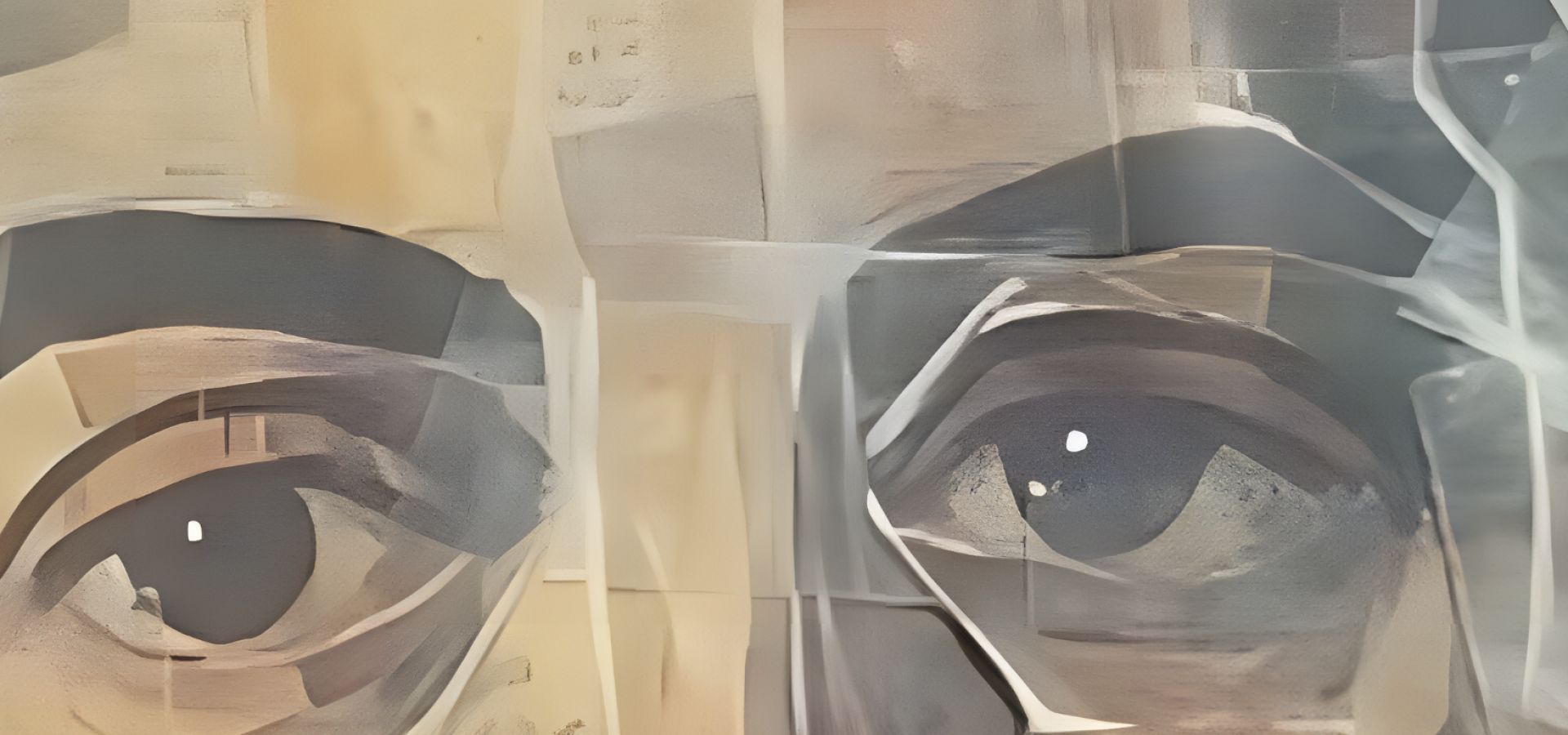
A young man gazes directly at the viewer. His dark brown eyes are almost impossible to look away from. The artist has captured an extraordinary sense of life in them. His clothes, like the rest of the painting, are rendered in muted shades of grey, sand, and brown. The accompanying text explains that, for the artist, painting is not an artistic choice but a necessity—a way of enduring and giving form to a world of destruction, dust, resistance, and suffering.
It was this portrait, from the exhibition Palestine/Israël: Pain and Hope, that lingered in my mind (see image 1 below). In a conflict where every word is scrutinised, contested, and answered, visual art serves a different purpose than language. It does not seek to persuade or explain. Instead, it invites us to pause—and simply to look.
Bearing Witness
Organised by the Dutch Network of the Anna Lindh Foundation in collaboration with, among others, Initiatives of Change, the exhibition brought together works by Palestinian artists and photographers at the Herberg van Menselijkheid (“Inn of Humanity”) in The Hague from 17 June to 8 July. Curated by Dr Afaf Badran, architect and environmental designer, it wove together paintings, photography, poetry, architectural works and personal stories exploring the human consequences of conflict: loss, displacement, fear, family, identity, resilience, and hope. The exhibition also included a selection of drawings by Israeli children.
Conversations about the Israeli-Palestinian conflict often become entrenched. Every word is weighed, challenged, and corrected. Before a person's story has truly been heard, the discussion shifts to history, responsibility, and competing narratives. In the process, the person behind the story can easily disappear from view.
Art asks something different of us. In philosophy and trauma ethics, this is often described as bearing witness. It does not require us to fully understand another person's experience, nor does it ask us to arrive immediately at a just solution. Rather, it asks us to remain present with another person's story—even when it unsettles us or challenges our own assumptions.
Bearing witness is not passive observation but a moral act. It means refusing to look away. It means recognising that another person's life matters. Art does not immediately turn us into experts or judges. It first invites us to become witnesses.
Pain
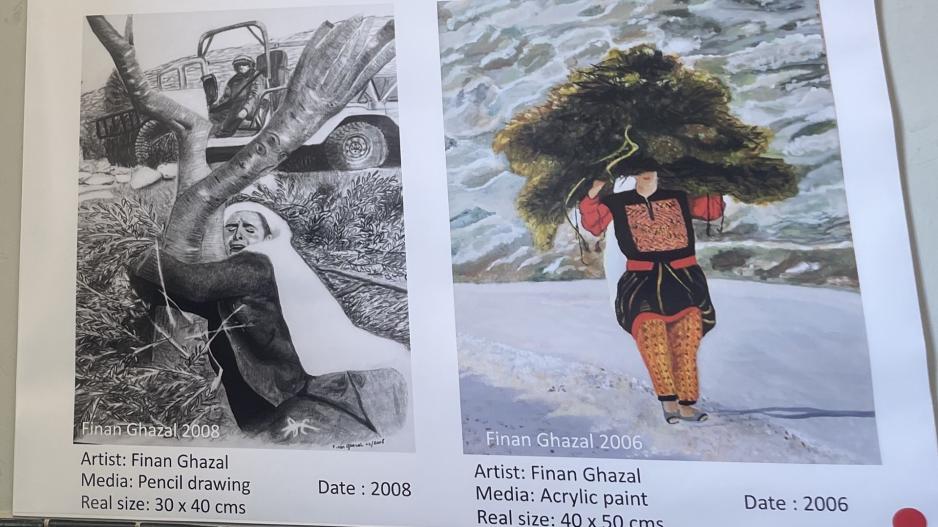
Another painting in the exhibition depicts a woman clinging desperately to a tree, as though it were the last thing anchoring her to the world (see image 2 on the left below). Behind her, a soldier aims his rifle in her direction. The scene is almost unnervingly still, yet its sense of threat is palpable. You do not need to know the woman's story to recognise her fear.
This is where art reveals its particular power. It does not first ask us which side someone belongs to. Instead, it invites us to dwell, however briefly, on what violence does to a human being. Not by simplifying the conflict, but by making human experience visible.
Moral Imagination
Throughout history, art has fulfilled this role time and again.
Harriet Beecher Stowe's Uncle Tom's Cabin (1852) stirred the conscience of American readers and gave renewed momentum to the abolitionist movement. Picasso's Guernica (1937), painted in response to the bombing of the Basque town during the Spanish Civil War, became one of the most enduring images of civilian suffering and the brutality of war. Neither work ended a conflict. Both, however, made it more difficult to look away.
This is art's distinctive contribution to society. Politics changes laws. Diplomacy negotiates. Humanitarian organisations save lives. Art protects something different: our moral imagination. Without it, we begin to reduce people to categories—refugee, enemy, Israeli, Palestinian, victim. Art resists that impulse towards dehumanisation. It reminds us that no human being can ever be fully defined by the category into which we place them.
Hope
The Israeli-Palestinian conflict will not be resolved through art. Political courage, diplomacy, justice, and security remain indispensable. Yet no lasting peace can be built if we come to see one another only as representatives of a nation, an ideology, or a history.
That is why art, literature, and personal stories are not merely companions to political processes; they are essential to them. They nurture something every just society depends upon: the capacity to be moved by another person's life. Not because they make our political choices for us, but because they prevent us from reducing a human being to the conflict they inhabit.
For me, this is also where the exhibition's hope resides. Not in the promise of an easy solution, but in the possibility that we continue to recognise one another's humanity—even amid media narratives, manipulation, and polarisation.
Of all the images and stories I encountered, one gaze has remained with me above all others: that of the young man from the beginning of this reflection. I still do not know who he is. I do not know his story, and I never will.
Yet I have found myself thinking about him often since visiting the exhibition. Wondering what his name might be. Where he is now. Without this portrait, he would probably have remained just another face passing through the endless stream of images that confront us every day.
I hope he is safe.
Shereen Siwpersad
The photographs are shown below. Hover over an image to view its caption.