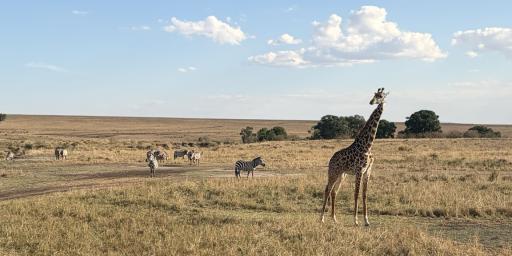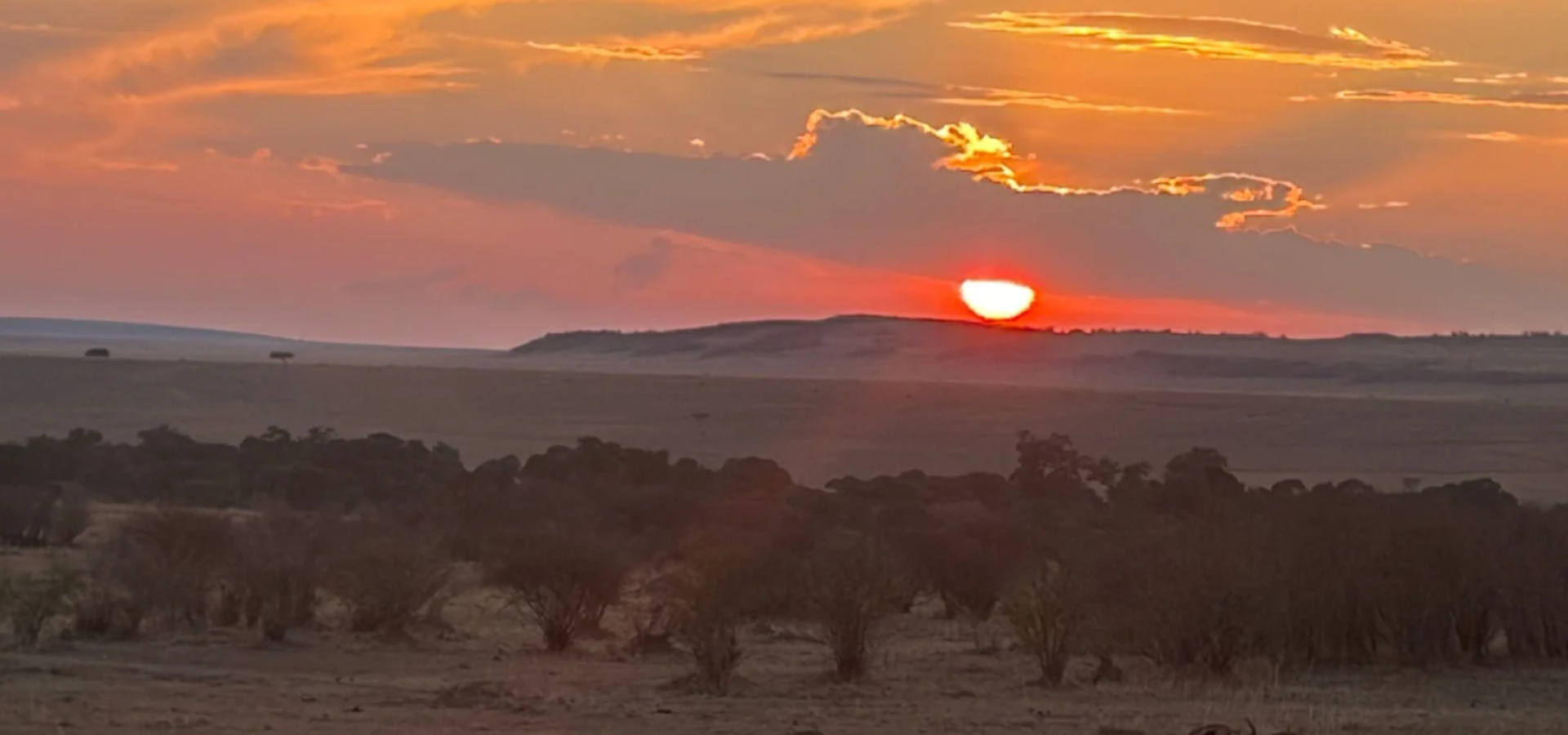
At sunset, the sky suddenly seems so close. It turns red, orange and gold, then deep black. The colours of the Maasai. In the distance, I see the silhouette of a lone giraffe, slowly but steadily following his own path. For a moment, I envy him. How wonderful to be so at ease. To know your way at all times. To move through the world without the weight of your own shortcomings.
I tell my guide, Gabriel, what is on my mind. He nods. Then he unfolds a picnic table and sets out a simple meal. He asks if we can pray before we eat.
I am not religious, but in the stillness of the savannah, I suspend my disbelief. Gabriel clasps his hands, and I open mine. I search for words:
to find my own way
to trust what I do not yet understand
to be kind to people and animals
to find abundance in bareness
to work towards a better world
amani — peace
Creators of Peace
Two weeks earlier, I arrive in Nairobi, Kenya. Around midnight, my travelling companion and I drive through the city towards the lodge where we will celebrate the thirty-fifth anniversary of Creators of Peace. Although I have worked at Initiatives of Change for years, I have yet to get to know this international women’s initiative. It brings women together to explore how peace begins with their own attitudes and actions, and how they can nurture it within their communities.
Over the next three days, I begin to understand what this means to the women involved. We talk, listen and spend time together. I meet women from Kenya, Rwanda, Cameroon, Uganda, India and Afghanistan, among other countries. Women I would probably never otherwise have met, whose experiences are far removed from mine and yet, at moments, feel so close.
Two of their stories stay with me in particular.
Forgiveness
Martha, from Kenya, is a mother of three. Following her arrest for theft, she was imprisoned with her baby. She speaks of the loneliness she experienced there, and of the judgment she faced after her release. Of how difficult it is to return to society when there is no safety net and people continue to condemn you for your past.
At Nakuru Women’s Prison, Martha encountered Creators of Peace. There, she began to reflect on her own experiences and feelings. She describes how this helped her make peace with herself and with those who had hurt her. Since her release, she has shared her experiences within her church and a group in her village.
What Martha says about forgiving yourself touches me most. It takes courage to face what you have done, but also to allow yourself a future afterwards. I recognise how self-punishment can become familiar: revisiting the same mistakes, passing the same judgment, never quite allowing yourself to move beyond them. The greater courage lies in what Martha describes: accepting what has happened, then finding a way to live well.
Compassion
Nadia’s story stays with me too. Growing up in Afghanistan, she assumed the identity of her late brother so that she could work under Taliban rule and support her family. She now lives in Spain, where, as a writer, human rights activist and founder of Ponts per la Pau, she works for peace and supports people affected by war and displacement.
As she tells her story, she speaks of her mother. Of how, after so much loss, her mother remained attentive to the suffering of others in the refugee camps. As I listen to Nadia speak, I recognise the same compassion she describes in her mother. She tells us that she has been able to forgive the people who hurt her. I try to imagine how you reach that point. What it takes, after everything she has lived through.
Listening to Martha, I find myself wondering how you forgive yourself. Listening to Nadia, I wonder how you forgive others. I carry both questions with me when I leave.
The Savannah
After the gathering, I leave for the Maasai Mara, about eight hours’ drive from Nairobi. I need space to absorb what I have heard and seen.
I, too, have acted in ways that conflict with my own values. Facing that hurts. The judgment I then pass on myself is merciless. Even as I write this, I am trying to find a way through.
At the gathering, I could listen to Martha’s words and recognise their wisdom. Here, in the stillness, I begin to feel what they ask of me.
Sitting with only my guide for company, I wonder what inner peace means in my own life. Perhaps it begins with being able to look honestly at my faults without condemning myself for them over and over again. To acknowledge the distance between who I have been and who I want to become, and still believe I can bridge that distance.
And yet I envy that giraffe. I imagine an existence without guilt, without shame, without endlessly replaying what should have been different. The innocence I see in him is my own longing: to be free, for a moment, from the weight of my judgment.
The savannah is at once harsh and vulnerable, merciless and infinitely gentle. The landscape stretches endlessly before me, yet I feel strangely confined. There is nowhere to turn but inward. Its bareness strips away the noise until the image I have held of myself begins to give way to something less flattering, less certain, but also more truthful. What remains on that bare plain is not emptiness, but fertile soil in which forgiveness and love might grow.
Peace
I wish I could write that I made peace with myself in Kenya. I am still a long way from that. Now that I am home, I am practising gentleness in how I judge others and myself. I understand better how vulnerable we become when we confront our own mistakes, and how crushing the judgment we pass on ourselves can be. Even when no one raises their voice. Even when there is only silence.
At Gabriel’s little table, I held my hands open. I did not know whom I was speaking to. But I knew what I hoped for.
To forgive and be forgiven.
Shereen Siwpersad